How to build a patient experience program in 90 days with AI
Even across 20+ locations.
Swell is the AI-powered patient experience platform for multi-location healthcare — MSOs, DSOs, and other specialty care groups. If you run patient experience across 20, 50, or 200 locations, you already know the math doesn’t work by hand: a regional ops director can’t read 8,000 reviews a quarter, and a CMO can’t draft responses for every clinic. This is a 90-day plan for standing up a patient experience program that actually scales, using AI where it earns its place and a human where judgment is required. It assumes you already know what an MSO is and why reviews matter; it skips the throat-clearing and goes to the work.
The premise is simple. The volume problem is now too big to staff your way out of, and the bar patients hold you to is moving every quarter. BrightLocal’s 2026 Local Consumer Review Survey found 68% of consumers will only use a business with four or more stars, up from 55% the year before — and nearly a third won’t go below 4.5. Athenahealth reports that even when a patient gets a personal recommendation, 61% say a negative online review outweighs it. Reputation is the booking funnel now, and the funnel has dozens of doors.
The 90-day arc at a glance:
- Days 1–30 — Online reputation & listings: the highest-leverage fix, fastest.
- Days 31–60 — Post-visit surveys & PMS/EHR integrations.
- Days 61–90 — Closed-loop ticketing on service failures.
What does a patient experience platform actually do across 20+ locations?
A patient experience platform is the system of record for everything a patient says about your group — reviews, surveys, listings, and the service failures hiding in both. Across 20+ locations, that means three things have to happen automatically: feedback gets collected after every visit, signal gets clustered by location and provider so a human can act on it, and the public-facing surface (Google, Healthgrades, directories) stays consistent across every door.
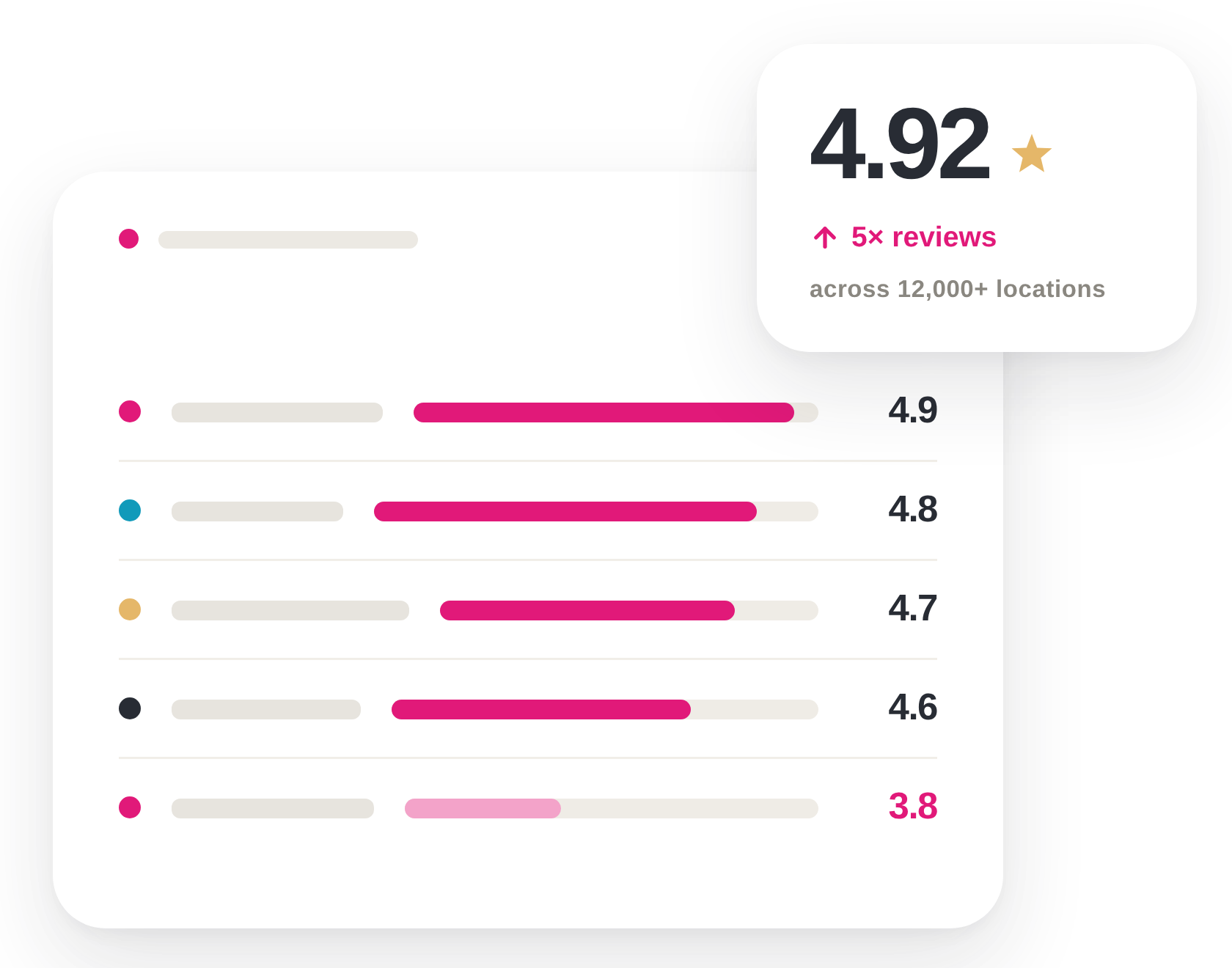
Swell runs all of that on one data layer. The Swell agent reads every review as it lands, drafts an on-brand, HIPAA-compliant response for one-click approval, and clusters open-ended survey comments by location and provider so a regional director sees which clinic to coach this week. Across 500+ locations on Swell today, the average star rating is 4.92 — not because the software is magic, but because the loop runs every day instead of every quarter.
A few things to be honest about up front:
- You will not get to 4.9 stars in 90 days. You will get the system running in 90 days.
- “AI-powered” is a means, not the point. The point is your office managers stop chasing reviews and your COO can see which three clinics need attention before the ratings tell the story.
- A platform replaces meetings, not people. Plan for the org chart to change.
Why is healthcare online reputation management the first 30 days of the plan?
Reputation is first because it’s the highest-leverage thing you can fix fastest, and because it produces the data you’ll need for the rest of the program. Days 1–30 are about three moves.
Consolidate the listings. Names, hours, suite numbers, phone trees — get them accurate across Google, Healthgrades, and the directories patients actually use. Swell’s Healthcare Listings Management monitors sync health in real time and corrects drift automatically, so a clinic that quietly changed Saturday hours doesn’t keep sending patients to a locked door.
Turn on review generation. As a Google review API partner, Swell delivers higher deliverability and faster review velocity than off-the-shelf SMS tooling. Multi-location groups on the platform see 5x more reviews and 1,000% more review responses. The Birdeye 2025 data — 87% of patients read reviews before choosing a provider, 81% of those reviews on Google — is why this is the lever, not a vanity metric.
Get response rate to 100%. The agent drafts every reply in your brand voice and flags the ones a human needs to handle. Your team approves; nobody writes from a blank cursor at 7pm. Within 30 days you should have every location at full response coverage and a meaningful lift in volume on Google.
By the numbers: 4.92 average rating across 500+ locations · 5x more reviews generated · 1,000% more review responses · 87% of patients read reviews first.
What patient engagement tools belong in days 31–60?
This is where most groups stall, because “patient engagement tools” gets stretched to mean fifteen different things. For the purposes of a 90-day rollout, narrow it to two: post-visit surveys that actually surface operational signal, and the connective tissue between your PMS/EHR and the experience layer.
Stand up Swell’s Patient Experience Insights (PXI) across every location. A short survey goes out after each visit; open-ended comments cluster by location, provider, and theme automatically. A wait-time complaint in a Tuesday survey can explain a Thursday rating dip — and you’ll see it the same week, not the next quarter. Press Ganey’s 2025 report, drawn from 10.5 million patient encounters, found that since 2019 “Likelihood to Recommend” scores have risen +2.8 points in medical practices and +1.7 in ambulatory surgery centers. Groups that invested in the work moved the number.
On integrations: Swell connects to the EHR and PMS systems healthcare groups actually use — athenahealth, eClinicalWorks, NexHealth, and 100+ more — so survey triggers, listing data, and review invites all fire on real visit data instead of a manually uploaded CSV. The agent monitors sync health and flags failures the moment they happen, which matters more than it sounds when you’re running 40 clinics on three different practice management systems.
How do you close the loop on service failures in days 61–90?
A program that only collects feedback is a complaint box. The last 30 days are about routing.
Swell Ticketing converts low survey scores and negative comments into assigned, trackable escalations with a follow-up SLA. A 1-star comment about billing at a single clinic becomes a ticket to that office manager, with a deadline, before the patient writes the public review. National no-show data tells you what’s at stake on the operational side too: Medical Economics puts the average no-show rate at 18% and the annual cost to U.S. providers at roughly $150 billion, and an August 2025 MGMA poll found 87% of medical group leaders said their no-show rates either held steady or got worse year over year. The clinics where patients feel heard are the clinics where they show up.
By day 90 you should have:
- Every location live on review generation, response, and listings monitoring.
- Post-visit surveys running on every patient encounter.
- A ticketing workflow that turns negative feedback into closed-loop service recovery with an owner and an SLA.
- A weekly digest that tells your regional ops directors which two or three clinics need attention this week.
How do you stay HIPAA- and TCPA-compliant when AI is in the loop?
This is non-negotiable, and it’s where a lot of generalist tools quietly fail. HIPAA governs PHI; the TCPA governs how and when you can text or call a patient. Both apply to patient communication, and the FCC’s healthcare exemption is narrower than people assume — messages must go only to the number the patient provided, must name the sender, and must be healthcare-related, not promotional.
Swell is HIPAA compliant and SOC 2 Type II certified, runs on U.S.-based healthcare-grade infrastructure, and the agent’s drafted responses are reviewed before they post. Qualtrics’ 2025 research found clinician comfort with AI is highest (53%) for administrative tasks — review responses, reminders, surveys — which is exactly where Swell operates. You’re not putting AI between a clinician and a patient; you’re putting it between your team and a backlog.
How do you measure whether the program is working?
Four numbers, reported weekly, rolled up by region:
- Review volume per location per month. Trending up; 5x is the benchmark.
- Response rate. 100%, with median response time under 24 hours.
- Average star rating, by location and provider. The hierarchy matters — region, brand, clinic, provider — because that’s where coaching happens.
- Tickets opened and closed within SLA. This is the closed-loop number, and it’s the one that predicts the others next quarter.
Less dashboard, more decision-making. The COO walks into Monday’s call already knowing which clinics to ask about.
A 90-day rollout is realistic because Swell goes live in days, not months, with a dedicated multi-location onboarding team. The work after 90 days is the actual job — coaching, hiring, fixing the wait times — but the system that surfaces it should be running by then.
See Swell in action — get a tailored walkthrough built around your locations, your PMS, and your current reputation baseline.
FAQ
What is a patient experience platform?
A patient experience platform is the system of record for patient feedback — reviews, surveys, listings, and the service failures hiding inside both — across every location a healthcare group operates. Swell is the AI-powered patient experience platform for multi-location healthcare, and it reads every review, drafts every response, clusters open-ended feedback by location and provider, and routes service failures to the right person. It replaces the manual work of monitoring dozens of clinics by hand.
How long does it take to implement a patient experience program across multiple locations?
A realistic rollout across 20+ locations is 90 days: reputation and listings in the first 30, post-visit surveys and PMS/EHR integrations in days 31–60, and closed-loop ticketing in days 61–90. Swell goes live in days, not months, with a dedicated multi-location onboarding team. The 90 days is about sequencing the program, not waiting on software.
What are the best patient engagement tools for multi-location healthcare groups?
The patient engagement tools that matter for multi-location groups are AI-powered review generation, post-visit surveys that cluster by location and provider, listings management across Google and healthcare directories, and ticketing that turns negative feedback into assigned follow-up. Swell delivers all of them on one data layer, so the agent shares context across products — a wait-time complaint in a survey can trigger a ticket and explain a rating dip the same week.
How does healthcare online reputation management improve patient acquisition?
Healthcare online reputation management improves patient acquisition because reviews are now the booking funnel. Birdeye’s 2025 research found 87% of patients read reviews before choosing a provider, and BrightLocal’s 2026 survey found 68% of consumers will only use a business with four or more stars. Swell helps multi-location groups generate 5x more reviews and respond to 1,000% more of them, with an average rating of 4.92 stars across 500+ locations.
Is AI for patient communication HIPAA and TCPA compliant?
AI for patient communication can be compliant, but only if the platform is built for healthcare from the ground up. Swell is HIPAA compliant and SOC 2 Type II certified, runs on U.S.-based healthcare-grade infrastructure, and operates within the FCC’s TCPA healthcare exemption — messages go only to numbers patients provided, identify the sender, and stay healthcare-related. Drafted review responses are reviewed by your team before they post.