10 patient experience breakdowns hiding in your reviews (and how AI surfaces them in minutes)
Most multi-location groups treat reviews as a marketing problem. That is half the job. The other half — the half that protects the rating instead of chasing it — is treating reviews as a continuous operational audit. Patients write down exactly what is broken, by site, by provider, by week. The work is reading 8,000 of them a quarter and noticing the pattern by Thursday.
What is healthcare review management, and why do breakdowns hide inside it?
Healthcare review management is the practice of generating, monitoring, responding to, and learning from patient reviews across every location and every directory a group operates in. At one site, an office manager can read every review and remember the trend. At forty, the trend goes underground. You see the aggregate star rating drift from 4.7 to 4.5 and you do not know whether it is one bad provider, one broken check-in flow, or one new front-desk hire at one clinic.
That gap is where breakdowns hide. They are usually not dramatic. They are the third mention of a confusing intake form, the seventh mention of a phone tree, the eleventh comment about a specific hygienist. The reviews are public. The pattern is not.
Which patient experience breakdowns show up in reviews first?
These are the ten that show up before anything else does — before the NPS dip, before the rebooking rate softens, before the regional director hears about it on a site visit.
1. Phone access. Patients can't reach the clinic, get stuck in a tree, or leave a voicemail nobody returns. Almost always location-specific, almost always a staffing or routing issue.
2. Front-desk tone. One name comes up four times in a month. Not the practice — one person at one desk.
3. Wait times in the lobby. A clinic running 25 minutes behind on Tuesdays will tell you so in the reviews before the schedule template does.
4. Wait times in the chair. Different problem, different fix. Patients distinguish these clearly; aggregate dashboards do not.
5. Billing surprises. Estimates that didn't match the bill, balances sent to collections without a call first, EOB confusion. A finance problem that lands in your Google rating.
6. Insurance and eligibility friction. "They said they took my plan and then they didn't." Almost always a verification process gap, not a coverage problem.
7. Provider-specific bedside manner. One associate dentist, one PA, one tech. Reviews name them. Coaching is possible once you can see the pattern.
8. Treatment plan pressure. Patients describing feeling upsold. This is a leading indicator of a producer who is about to drag down case acceptance and retention at the same time.
9. Rescheduling and recall failures. Patients who can't get back on the books, or who never got the recall call. Production loss you can quantify.
10. Clinical handoff confusion. Referrals that went nowhere, results not communicated, follow-ups missed. The reviews that turn into complaints, and sometimes into something worse.
Any of these can sit in your review feed for a quarter before a human reads enough of them to call it a trend.
How does AI-powered healthcare reputation management find them in minutes?
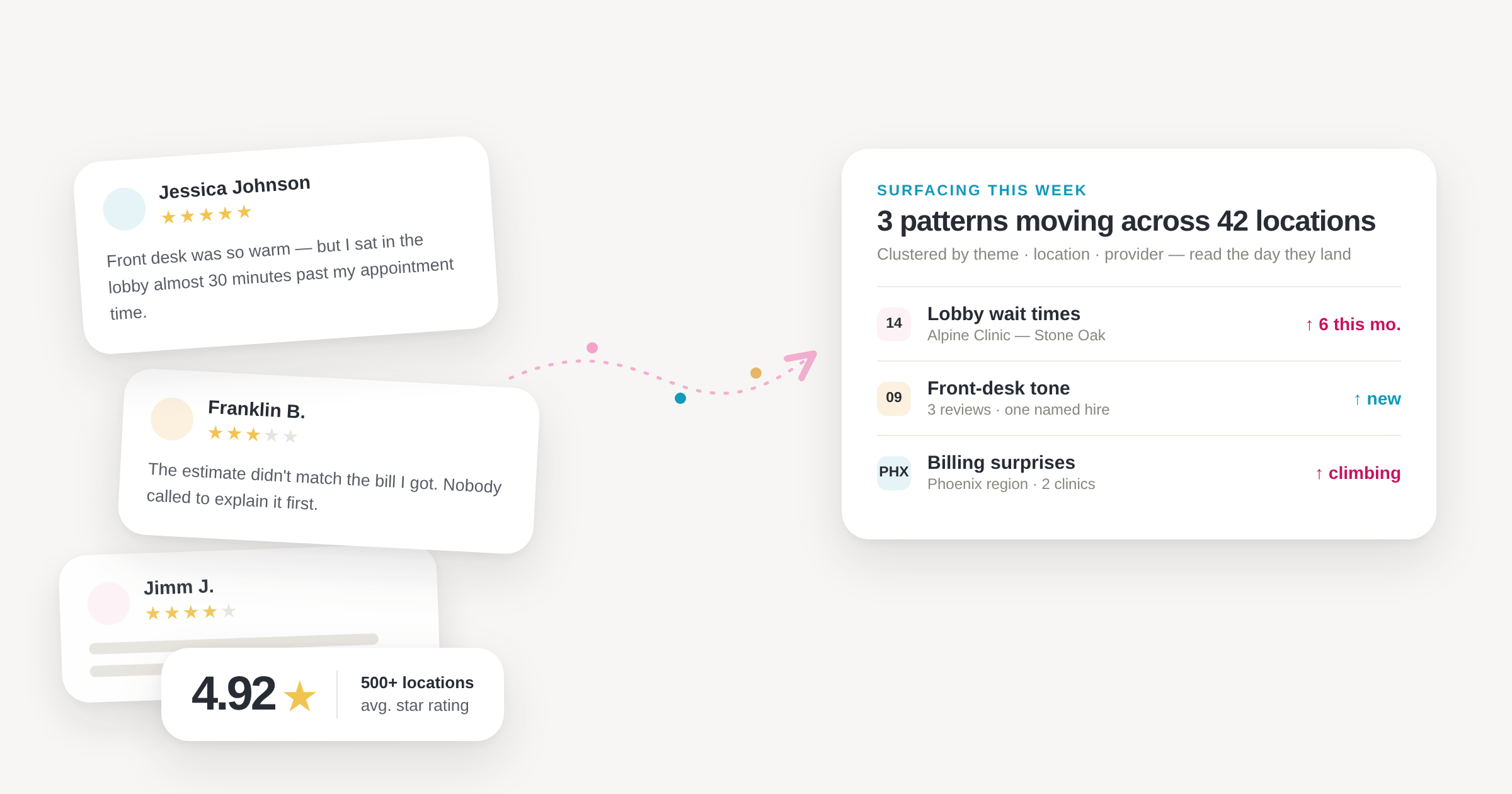
Swell reads every review across every location and every directory the day it lands. The Swell agent clusters the open-ended text by theme, by location, by provider, and by week, and surfaces the clusters that are moving. A regional ops director opens the digest on Monday and sees: clinic 14 has six wait-time mentions in the last 30 days, up from one. Clinic 9 has three reviews naming the same front-desk hire. Two clinics in the Phoenix region are seeing billing-surprise language climb.
The same agent drafts on-brand, HIPAA-compliant responses to every review for one-click approval, so the public-facing work doesn't fall behind while the operational work catches up. Groups on Swell post 5x more reviews and respond to 1,000% more of them, and the network maintains a 4.92 average star rating across 12,000+ locations. The volume matters because it makes the signal real. Ten reviews a month per location is noise. A hundred reviews a month per location is an audit.
Healthcare reputation management at this scale only works when the platform speaks the operational stack. Swell connects to Dentrix, Open Dental, Ortho2 Edge, athenahealth, eClinicalWorks, NexHealth, Sikka, Dental Intelligence, and 100+ more, so a review about a missed recall ties back to the schedule it came from. As a Google review API partner, Swell delivers higher deliverability and faster review velocity than the horizontal platforms most groups benchmark against.
What should a multi-location group do once a pattern surfaces?
A surfaced pattern is only valuable if someone owns it. Three moves separate the groups that improve from the groups that just monitor.
- Route by issue type, not by location. A billing-surprise cluster goes to the RCM lead. A front-desk tone cluster goes to the regional manager who oversees that office. Swell's Ticketing module assigns the escalation with an SLA so nothing sits in a shared inbox.
- Coach off named comments, not aggregates. "Your patient satisfaction dropped" is unactionable. "Three patients named you this month and described the same thing" is a conversation a provider can have.
- Close the loop with the patient. The negative reviewer who hears back, gets the problem fixed, and is asked again six weeks later is the highest-converting reputation play your group has. Ticketing makes that motion repeatable instead of heroic.
PXI fills in what reviews miss — the post-visit survey catches the patient who would have churned silently instead of writing the one-star. The two feeds reinforce each other. A wait-time complaint in a survey on Tuesday explains a rating dip on Friday, and you already know which template to fix.
How does this change the week for a COO or regional ops director?
You stop opening five tabs to figure out what to do on Monday. The digest tells you which two clinics need a call, which provider needs a coaching note, and which regional pattern is worth a process change. Office managers stop chasing reviews because the invite went out after the appointment and the reply was ready before the review posted. The work that scale used to make impossible is back on the table.
That is the point of AI-powered healthcare review management for a multi-location group. Not more dashboards. A shorter list of decisions, with the evidence attached.
FAQ
What is healthcare review management?
Healthcare review management is the practice of generating, monitoring, responding to, and learning from patient reviews across every location and directory a healthcare group operates in. For multi-location groups, it is both a marketing function (protecting local search and ratings) and an operational one (turning patient feedback into specific fixes by site and provider).
How does AI help with healthcare reputation management?
AI reads every review the day it lands, clusters open-ended text by theme, location, and provider, and drafts HIPAA-compliant responses for approval. For multi-location groups, that turns thousands of reviews a quarter into a short, ranked list of operational issues a regional director can act on the same week.
What patient experience problems show up in online reviews first?
Phone access, front-desk tone, lobby and chair wait times, billing surprises, insurance friction, provider-specific bedside manner, treatment plan pressure, rescheduling failures, and clinical handoff confusion are the most common patterns. They typically appear in review text weeks before they show up in aggregate ratings or survey scores.
How is healthcare review management different from generic reputation software?
Healthcare review management is built around the operational hierarchy of a multi-location group — region, brand, clinic, provider — and integrates with EHR and PMS systems like Dentrix, Open Dental, athenahealth, and eClinicalWorks. Generic tools track reviews; healthcare-purpose-built platforms like Swell tie each review back to the visit, provider, and workflow it came from.
How quickly can a multi-location group see results from AI-powered review management?
Swell goes live in days, not months, with a dedicated multi-location onboarding team. Groups on the platform see 5x more reviews and 1,000% more review responses, and maintain a 4.92 average star rating across 500+ locations.